
The Small Odds Trap: Why “Safe” Accumulator Bets Are Riskier Than They Look
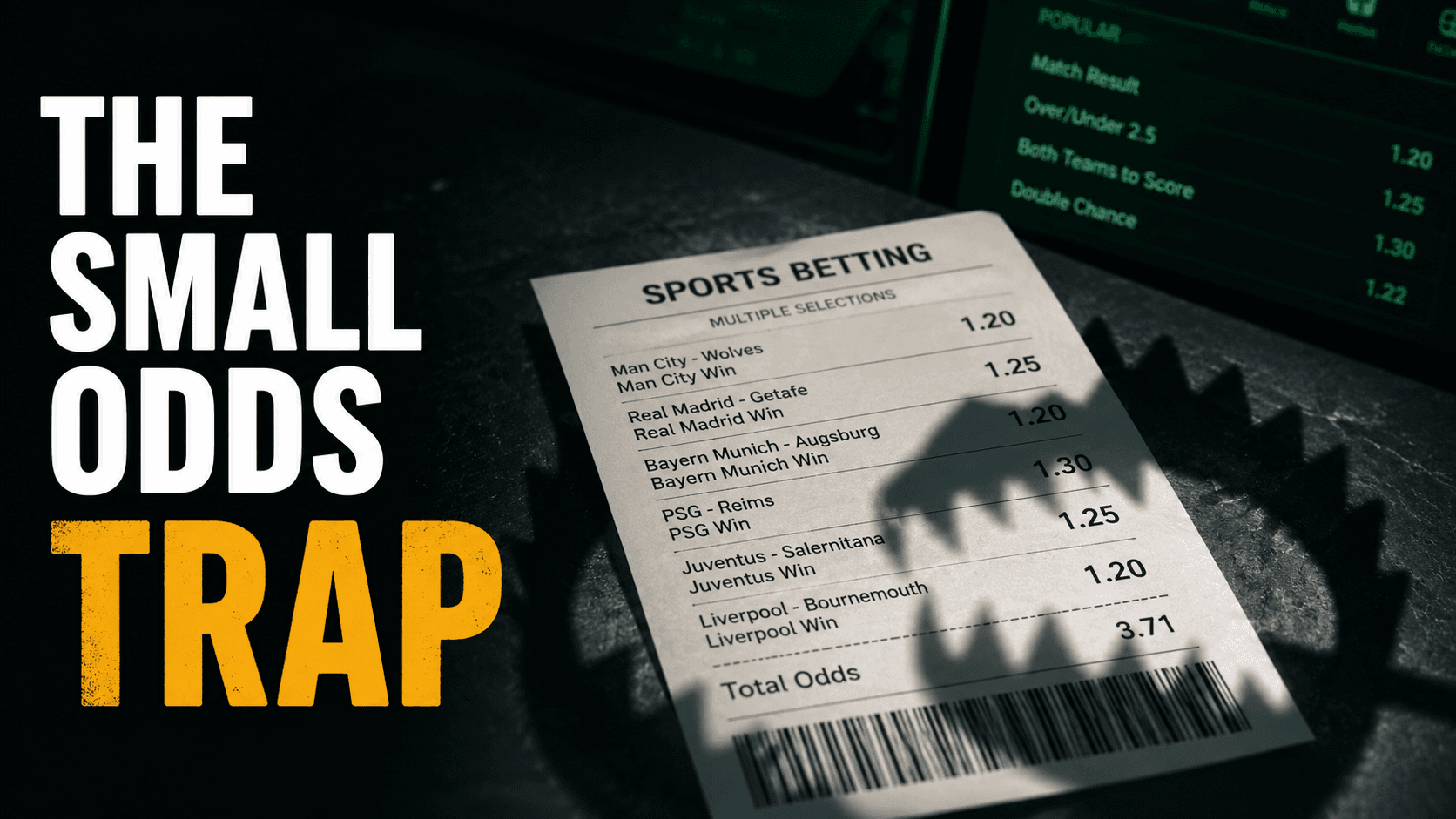
The Small Odds Trap: Why “Safe” Accumulator Bets Are Riskier Than They Look How small odds create emotional comfort, hide real probability, and quietly turn a “safe” bet slip into a fragile ticket.
Most bettors are not afraid of 1.20 odds.
That is exactly the problem.
A 1.20 selection looks harmless. It looks like the kind of pick you add to a bet slip when you want to “make the odds stronger” without taking too much risk. It feels safe. It feels responsible. It feels like the kind of odds that should not disappoint you.
But if you have ever played sports betting for some time, you probably know the painful story already.
You avoid the big odds because you do not want trouble. You ignore the 2.50, the 3.00, the risky away win, the unpredictable derby. Then you build what looks like a safe ticket: 1.20 here, 1.25 there, 1.30 somewhere else. By the time you are done, the total odds look attractive. Maybe 4.50. Maybe 5.00. Maybe even more.
Then one match spoils everything.
Not the match you feared. Not the one you expected to be dangerous. Most times, it is one of the so-called “sure” games.
That is the small odds trap.
A small odd is not dangerous because it is small. It becomes dangerous when you start treating it like it cannot fail.
The mistake is not always the prediction
Many bettors think a lost accumulator means they picked the wrong team. Sometimes, yes, that is true. But many times, the deeper mistake started before the match even kicked off.
The mistake was in how the risk was understood.
Most people judge a bet slip by looking at each selection one by one.
They see:
- 1.20 and think, “safe”
- 1.25 and think, “very possible”
- 1.30 and think, “reasonable”
- 1.35 and think, “this should enter”
But the bookmaker is not looking at your slip with that same emotion. The bookmaker is looking at the full structure.
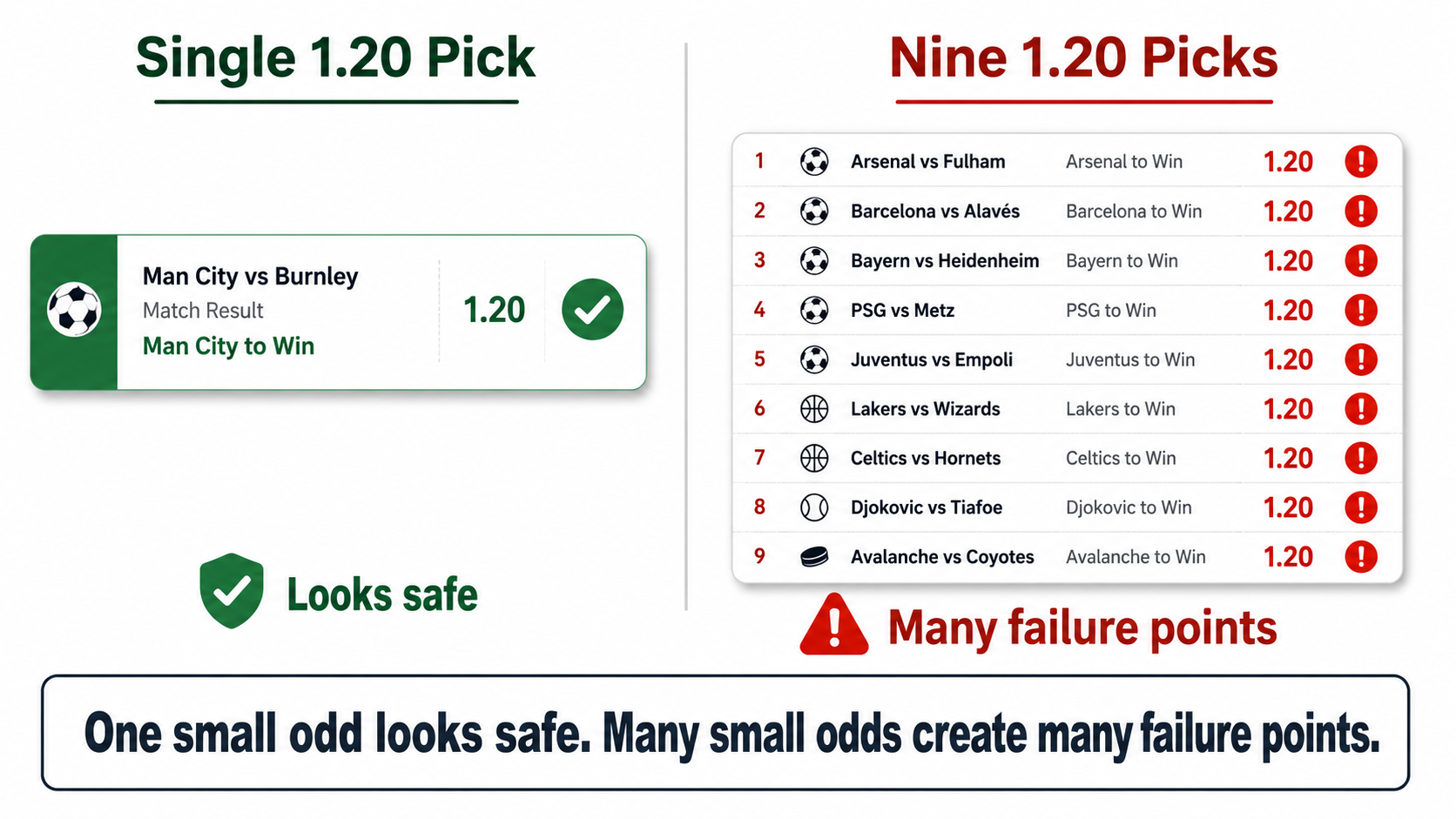
You are not asking one strong team to win. You are asking five, seven, nine, or ten different events to all go your way.
That is a very different thing.
Odds are probability wearing a different shirt
Before we go deeper, one thing needs to be clear:
Odds are not just payout numbers. Odds are probability in disguise.
When you see odds, you are also seeing what chance the market is roughly assigning to that outcome.
For example:
| Odds | Approximate implied chance |
|---|---|
| 1.20 | 83.3% |
| 1.50 | 66.7% |
| 2.00 | 50% |
| 2.50 | 40% |
| 5.00 | 20% |
A 1.20 odd looks strong because it suggests the event has a high chance of happening. But high chance does not mean certainty.
If something has an 83% chance of happening, it also has around a 17% chance of not happening.
That 17% may look small when you are dealing with only one game.
But when you start adding multiple games, the risk begins to stack.
Small risk repeated many times can become big risk.
The 1.20 accumulator trap
Let’s use a simple example.
One selection at 1.20 looks safe.
But what happens when you combine nine selections of 1.20?
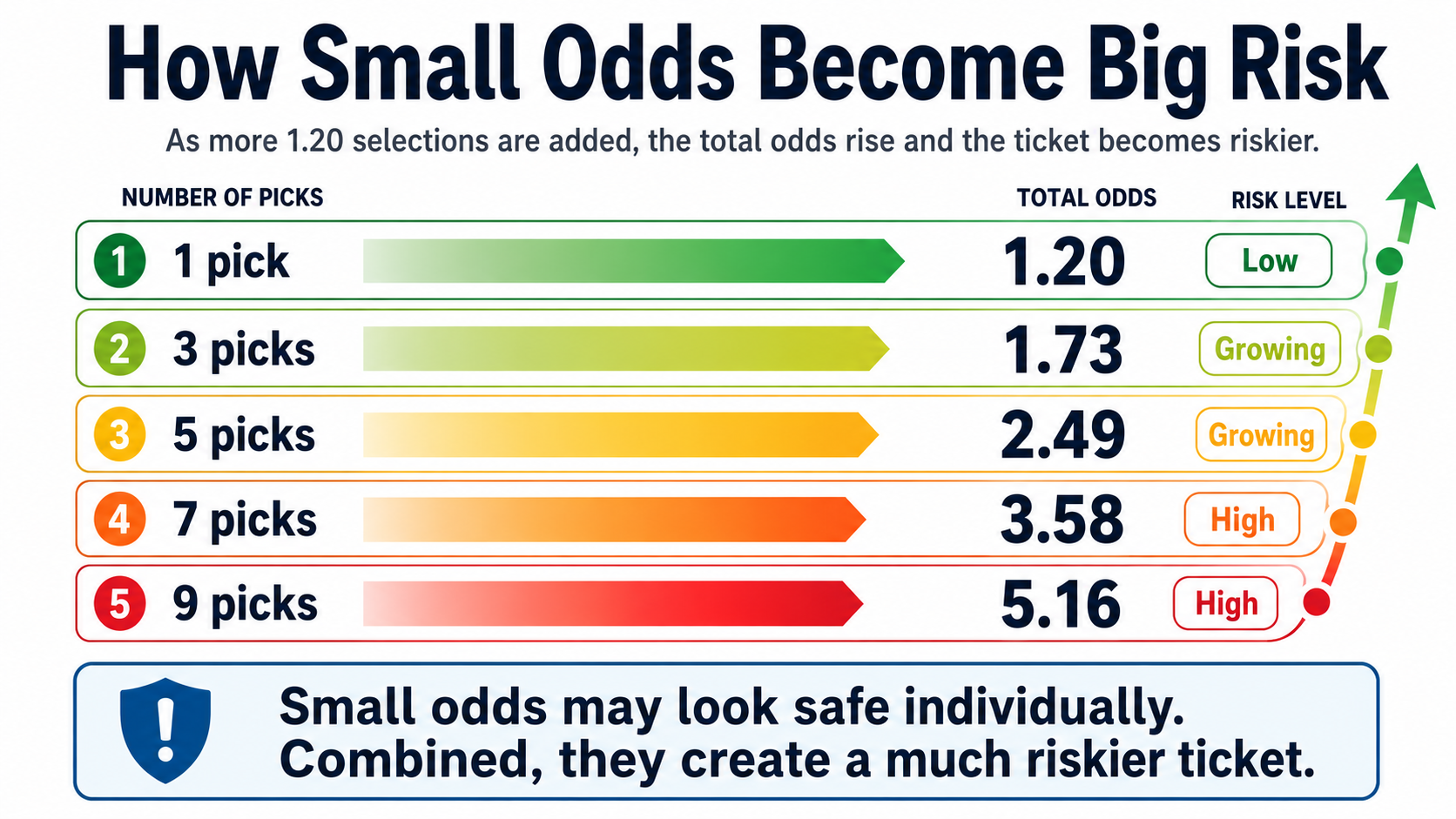
1.20 × 1.20 × 1.20 × 1.20 × 1.20 × 1.20 × 1.20 × 1.20 × 1.20 = 5.16Now pause for a moment.
A ticket of total odds 5.16 is not a small-risk ticket.
It may be built from small odds, but the final ticket is no longer small. It has become a high-risk accumulator wearing the costume of safety.
That is where many bettors deceive themselves.
They would never confidently say, “Let me play one risky 5.00 odds selection.” But they will build almost the same risk by stacking many tiny odds together.
The slip feels safer because each individual selection looks safe.
But the total ticket is telling a different story.
The ticket has more doors for failure
This is the part that most bettors feel emotionally, even if they do not explain it mathematically.
A single bet has one main door for failure.
An accumulator has many doors.
If you place nine matches, you have opened nine different doors where something can go wrong.
- One red card.
- One missed penalty.
- One rotated squad.
- One late equalizer.
- One team that dominates possession but cannot score.
- One referee decision.
- One favorite that plays like they are tired.
- One match where the stronger team scores early and stops attacking.
- One “sure” team that suddenly decides to respect the opponent too much.
That is why accumulators are painful. They do not need everything to go wrong. They only need one thing to go wrong.
An accumulator does not fail because all your picks were bad. It fails because one pick was enough to kill the whole slip.
This is why many bettors feel more pain when one game spoils the ticket. The whole slip may have looked intelligent. Eight matches may have entered. But one “small” game ruins the result.
That pain is not random. It comes from how the ticket is built.
Why small odds feel safer than they are
The danger of small odds is psychological.
When a bettor sees 1.20, the brain does not see probability. It sees comfort.
It says:
“This one should enter.”
That phrase, “should enter,” is where the problem starts.
Football does not care what should enter.
Basketball does not care what should enter.
Sports do not follow our emotional confidence. They follow events, mistakes, pressure, tactics, fitness, motivation, and sometimes pure randomness.
A team can have better players and still fail to win.
A favorite can dominate and still draw.
A match can look simple on paper and become complicated after ten minutes.
This does not mean small odds are useless. It means small odds should still be respected.
The moment you stop respecting the risk, the odds become dangerous.
The bookmaker understands this psychology
Bookmakers know that most bettors fear big odds more than small odds.
A bettor may look at 2.50 odds and say:
“This is too risky.”
But the same bettor may combine six or seven smaller selections and end up with the same kind of risk without realizing it.
That is one reason accumulators are so popular.
They allow bettors to feel safe while chasing bigger payouts.
The bookmaker does not need to force anybody. The design is already attractive.
Small odds give emotional comfort.
Total odds give excitement.
The combination is powerful.
You feel like you are being careful, but you are still chasing a big return.

The real question is not “Is this odd small?”
A better question is:
“What is the real chance that all these selections happen together?”
That is the question most bettors skip.
They focus on each match individually:
- “Can Arsenal win?”
- “Can Madrid avoid defeat?”
- “Can City score over 1.5?”
- “Can this team get one goal?”
Those questions are fine, but they are incomplete.
The full question should be:
“Can all of these things happen on the same ticket?”
That changes everything.
A single event may be likely.
But five likely events together are not as safe as they look.
Nine likely events together are even more fragile.
The more selections you add, the more your ticket depends on perfection.
And perfection is expensive in sports betting.
Small odds are not the enemy
This article is not saying that every small odd is bad.
That would be too simple.
Sometimes, a small odd can be reasonable. Sometimes, it can even be useful. The problem is not the existence of small odds.
The problem is when bettors use small odds as emotional protection.
They say:
“Let me add this one. It is only 1.20.”
Then they add another.
And another.
And another.
Before long, the ticket is no longer built from analysis. It is built from comfort.
That is dangerous.
Every selection on a slip should earn its place. Not because the odds are small, not because the team is popular, not because the bookmaker placed it under “top picks,” but because the selection makes sense.
If you would not trust the match on its own, why add it to destroy an entire ticket?
Every selection you add should earn its place. A small odd can still be the weakest link on your ticket.
The hidden cost of “just one more game”
There is a common habit in betting.
A person builds a slip and sees the total odds are not attractive enough.
Maybe the odds are 2.10.
Then they say:
“Let me add one more safe game.”
That one more game raises the odds to 2.60.
Then another one raises it to 3.20.
Then another raises it to 4.00.
At each step, the bettor feels like they are improving the payout. But they may also be weakening the ticket.
Because every extra game adds a new condition.
The ticket now needs more things to go right.
This is how a decent slip becomes a fragile slip.
Not all at once. Slowly.
One “safe” addition at a time.
The painful truth about “sure games”
In sports betting, the word “sure” is dangerous.
There are likely outcomes. There are strong favorites. There are good spots. There are weak opponents. But there are no guaranteed matches.
A 1.20 odd does not mean “sure.”
It means the market believes the outcome is likely. That is all.
Likely can still fail.
And when you combine many likely outcomes, you are not creating certainty. You are creating dependency.
Your ticket depends on every single one of them behaving as expected.
That is why the so-called safest pick can become the most painful one.
Because you did not prepare emotionally for it to fail.
What bettors should take away
The biggest lesson is simple:
Do not judge a bet slip by how small each odd looks. Judge it by the total risk.
A ticket with many small odds can be just as dangerous as a ticket with fewer bigger odds.
The difference is that the bigger odds look risky from the beginning, while the small odds hide the risk until the slip is already built.
That is why the small odds trap is so effective.
It does not feel like a trap.
It feels like wisdom.
It feels like discipline.
It feels like safety.
But if the ticket needs seven, eight, or nine different things to happen perfectly, then it is not as safe as it looks.
Final thought
Most bettors do not lose accumulators because they are foolish.
Many lose because they misunderstand what the slip is asking from reality.
A 1.20 selection can be a strong pick.
But nine 1.20 selections are not one strong pick. They are nine separate risks tied together.
That is the part many people forget.
The next time you look at a bet slip full of small odds, do not only ask:
“Can each of these happen?”
Ask:
“What are the chances that all of them happen together?”
That question alone can change the way you look at betting slips.
Because in the end, the danger is not always in the big odds everyone fears.
Sometimes, the real danger is hidden inside the small odds everyone trusts.
Ready to win big today?
Get our expert-analyzed, high-accuracy sports predictions for today's matches.
Get Free Prediction For Today